Engineering
AI Governance for Enterprise Code: What an Audit Trail for AI-Generated Software Must Actually Contain
Most enterprises have an AI governance policy. Almost none can prove it was followed.
Most enterprises have an AI governance policy. Almost none can prove it was followed.
That's where AI governance actually breaks down - not in the boardroom where the policy was written, but in the delivery pipeline where engineers are shipping AI-generated code under deadline pressure. If your organization is using AI agents to produce software and you can't reconstruct exactly what was decided, by whom, and on what basis, you don't have AI governance. You have a document that says you do.
This article is for CTOs, VPs of Engineering, and Chief AI Officers facing a harder question than "do we have a policy?" The question auditors, regulators, and your own board are starting to ask is: can you prove it was followed - line by line, commit by commit?
The Governance Gap Is Already Showing Up in the Data
According to an EY survey published in September 2026, 47% of organizations have bypassed their own AI governance process for urgent deployments - despite 98% of those same organizations having formal AI governance policies in place. That isn't a policy problem. It's a structural one. When governance lives outside the delivery pipeline as a checklist, it gets skipped the moment a deadline moves.
The same EY research found that 26% of agentic AI users cannot detect unauthorized AI agents operating inside their own organization. That figure should concern any executive accountable for regulated software delivery. Agents may be producing code in systems you don't know about, with no record of what they generated or why.
Gartner's May 2026 analysis adds a forward-looking warning: by 2027, 40% of enterprises are expected to demote or decommission autonomous AI agents specifically because of governance failures. The organizations that avoid that outcome will be the ones that built governance into their delivery architecture from the start - not the ones that tried to retrofit it afterward.
What a Defensible AI Audit Trail Must Actually Contain
An audit trail for AI-generated software isn't the same as application logging. Logging tells you what happened to the system. An audit trail for AI governance tells you who authorized what, with what intent, at what point in the process, and whether a qualified human reviewed it before it reached production.
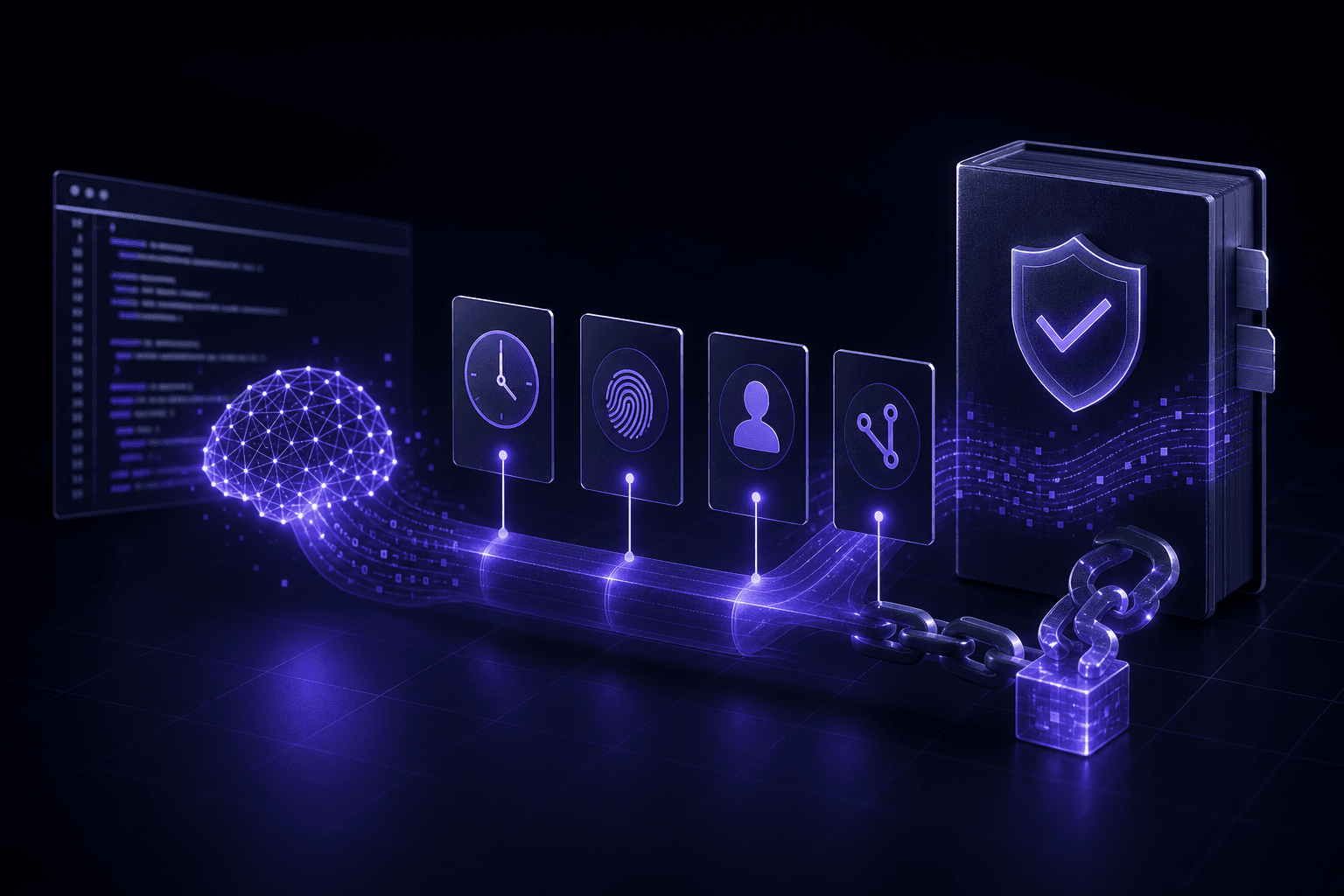
Based on the Kognitos 2026 governance checklist, a defensible audit trail requires at minimum four things for every AI-assisted decision that affects production code:
An NTP-synced UTC timestamp. Not a local server time. Not an approximate date. A cryptographically anchored timestamp that can be independently verified and cannot be retroactively altered. Regulators under SOX, FedRAMP, and the EU AI Act need to establish sequence of events. Unreliable timestamps make the entire audit trail unreliable.
A unique decision ID. Every AI-generated artifact - a requirement, a blueprint, a work order, a code commit - needs a stable, unique identifier that traces back to the original intent that triggered it. Without this, you cannot reconstruct the chain of causation from business requirement to production code.
Authenticated human identity, not a service account. This is the one most organizations get wrong. When a service account or shared credential approves a change, there's no way to establish who was actually accountable. Auditors under HIPAA, ISO 42001, and the EU AI Act are specifically looking for named human accountability at approval gates. A service account is not a person. It cannot be held responsible, and it cannot testify to intent.
Evidence of what changed and why. The audit trail must capture not just the final state of the code but the delta - what was different, what decision produced that difference, and what human reviewed and approved it. This is what separates a compliance artifact from a compliance performance.
Codacy's August 2026 analysis of enterprise AI audits makes the shift explicit: auditors are no longer asking whether you have an AI policy. They're asking whether you can prove it was followed. The emerging concept of an AI Bill of Materials (AIBOM) - a structured record of every AI model, agent, and decision that touched a piece of software - is moving from theoretical to expected in regulated industries.
Why Bolted-On Logging Tools Don't Solve This
The instinct many engineering teams have is to add an observability layer or a logging wrapper on top of whatever AI tooling they're already using. This approach fails for a structural reason: it records what happened after the fact, but it doesn't enforce governance during the process.
A log that says "Agent X generated this code at 14:32 UTC" is not the same as a system that required a named human to review and approve that code before it could reach production. One is a record. The other is a control.
The Retool 2026 AI Governance Report found that 93% of senior technology leaders are concerned about ungoverned AI code reaching production. The concern is well-founded, but concern doesn't close the gap. The gap closes when the approval gate is structurally mandatory - when the pipeline cannot advance without a qualified human sign-off, and when that sign-off is recorded with authenticated identity and a tamper-evident timestamp.
Dataiku's 2026 Harris Poll found that 92% of enterprise CIOs have been asked to defend AI outcomes they couldn't explain. That's not a communication problem. It's an architecture problem. If the system that produced the outcome didn't record the reasoning, the decision chain, and the human authorization, there's nothing to explain. You're reconstructing after the fact - which is exactly what regulators and auditors are trained to distrust.
Governance Baked Into the SDLC, Not Bolted On After
The difference between governance as a document and governance as an architecture is where Lumaq's approach becomes relevant for enterprise teams under compliance pressure.
Lumaq operates as a single control plane across the entire software development lifecycle. Plain-language intent or a legacy codebase goes in. Requirements, blueprints, work orders, and tested code come out - connected by a tamper-evident graph that links every artifact back to the original intent that produced it. That graph is the audit trail. It isn't generated after delivery. It is the delivery record.
Critically, agents in Lumaq propose. They do not merge. Every artifact moving toward production passes through a mandatory human approval gate. The approver is authenticated - not a service account, not a shared credential. That approval is recorded in the same tamper-evident graph as the artifact it authorized. Separation of duties is built into the pipeline, not added to it.
The output - code, IP, models, and the full audit trail - is owned entirely by the customer. It runs on-prem, in a private cloud, or air-gapped. There is no vendor dependency on the audit record itself. When a regulator asks for the trail, the customer produces it from their own environment, under their own control.
This architecture directly addresses what the EU AI Act, ISO 42001, SOX, FedRAMP, and HIPAA are converging on: not just that AI was used, but that a qualified human reviewed and authorized each consequential decision, and that the record of that authorization is intact, attributable, and independently verifiable.
What This Looks Like Across the SDLC
The governance graph connects every stage. A business requirement entered as plain language is assigned a unique ID. The blueprint derived from it inherits that lineage. The work orders generated from the blueprint carry the same chain. The code produced from those work orders is traceable back to the original intent, with every human approval recorded at each transition point.
If an auditor asks why a particular function was written a certain way, the answer isn't "the AI did it." The answer is a documented requirement, a blueprint decision, a work order, a human approval, and a commit - all linked, all timestamped, all attributed to named individuals.
That's what a defensible audit trail looks like in practice.
The Speed Problem Isn't What You Think
The GitLab 2026 AI Accountability Report found that 78% of developers write code faster with AI assistance - but delivery speed hasn't improved at the same rate. The bottleneck isn't generation. It's the absence of a governed path from generation to production.
When AI-generated code has no clear audit trail, it stalls in review cycles, triggers compliance holds, or gets quietly deprioritized by risk-averse teams. Governance built structurally into the pipeline - rather than reviewed at the end - removes that stall. The approval gate becomes a checkpoint, not a barrier, because the evidence required to pass it was captured automatically throughout the process.
FAQs
What is an AI audit trail for software, and why does it differ from standard application logging?
Standard application logging records system events after they occur. An AI audit trail for software governance records who authorized each AI-generated artifact, on what basis, and whether a qualified human approved it before it reached production. The distinction matters to regulators because logging is observational while an audit trail is evidential.
Which compliance frameworks specifically require human accountability in AI-assisted software delivery?
The EU AI Act, ISO 42001, SOX, FedRAMP, and HIPAA all converge on the requirement for named human accountability at consequential decision points. The EU AI Act is the most explicit, requiring documented human oversight for high-risk AI systems - including software that affects regulated processes.
What is an AI Bill of Materials (AIBOM) and do we need one?
An AIBOM is a structured record of every AI model, agent, and decision that contributed to a piece of software. It's analogous to a software bill of materials (SBOM) but extended to cover AI-generated components and the decisions that produced them. Regulated industries are moving toward treating it as expected rather than optional.
Why is a service account insufficient for an AI governance audit trail?
A service account cannot be held accountable, cannot testify to intent, and cannot establish that a qualified human reviewed a decision. Regulators and auditors under frameworks like HIPAA and ISO 42001 require named human identity at approval gates. A service account approval is a gap in the chain of accountability, not evidence of it.
How does a mandatory human approval gate differ from a standard code review?
A standard code review is a team practice that can be skipped, delegated, or bypassed under deadline pressure. A mandatory approval gate is a structural control - the pipeline cannot advance without it, and the identity of the approver is recorded in the same tamper-evident record as the artifact being approved. The governance value comes from the fact that it cannot be bypassed without leaving a detectable gap in the audit trail.
What does "tamper-evident" mean in the context of an AI audit trail?
Tamper-evident means any alteration to the audit record after the fact is detectable. This is typically achieved through cryptographic linking of records, NTP-synced timestamps, and immutable storage. It's the property that allows an auditor to trust that the record they're reviewing reflects what actually happened - not a post-hoc reconstruction.
How should we approach AI governance if we're already mid-deployment with AI-generated code in production?
Start by establishing what you can reconstruct: which AI tools produced which artifacts, what human reviews occurred, and whether any approval records exist. From that baseline, prioritize adding structural controls to the forward pipeline before expanding AI-assisted delivery further. Retroactive documentation has limited regulatory value; prospective governance architecture is what auditors and regulators are looking for.
If your organization is scaling AI-assisted software delivery under compliance pressure, the question worth asking now is whether your current pipeline could produce a defensible audit trail on request - not in theory, but in practice, for a specific commit, today.
Learn more at lumaq.ai.