Delivery
Governed vs. Ungoverned AI Software Delivery: Why Faster Code Isn't Faster Delivery in the Enterprise
Faster code generation is not the same as faster, safer, production-ready delivery.
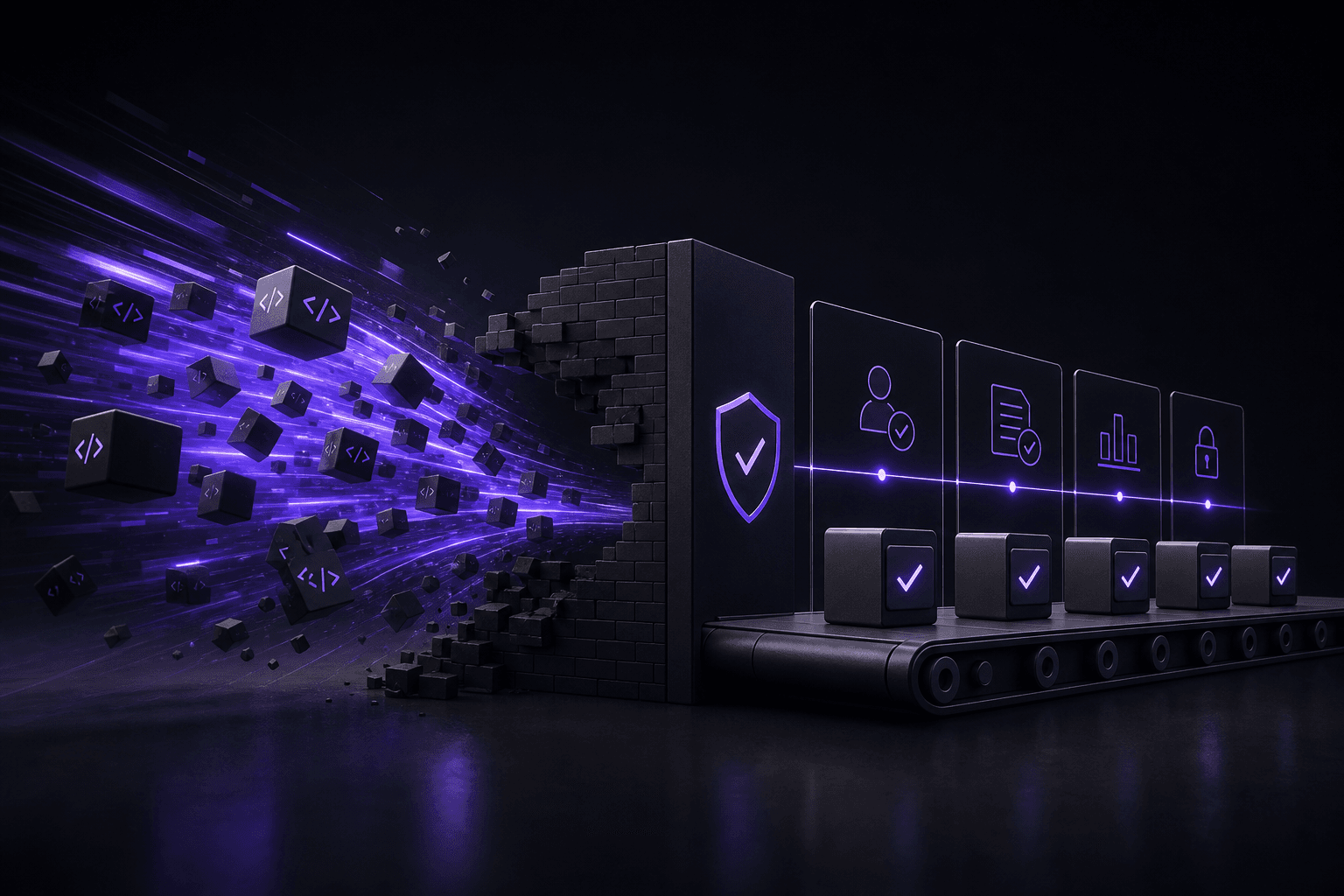
AI in software development has created a genuine paradox for enterprise engineering leaders in 2026. Individual developers are writing and committing code faster than ever. Yet delivery - the thing that actually matters to the business - hasn't accelerated at the same rate. If your organization has adopted AI coding tools without a governance layer, you're probably living inside that gap right now.
This article is written for CTOs and VP Engineering leaders at enterprises where AI coding tool adoption is already underway but the structural controls haven't kept pace. The argument is straightforward: ungoverned AI delivery creates a different kind of risk than slow delivery, and that risk compounds quietly until it surfaces as a compliance failure, a production incident, or a security audit that stops everything.
The AI Productivity Paradox
The productivity signal is real. According to the GitLab 2026 AI Accountability Report, 78% of developers say they write and commit code faster with AI assistance. That number is hard to argue with, and it's the figure most often cited when organizations justify expanding AI tool access.
But the same report found that 79% of respondents say overall delivery pace hasn't accelerated at the same rate as individual coding speed. Faster code generation is not the same as faster, safer, production-ready delivery. The gap between those two things is where ungoverned AI adoption lives.
The explanation isn't complicated. When individual developers produce more code faster, the downstream processes - review, security scanning, compliance checking, approval, deployment - face higher volume without necessarily having more capacity or better tooling to handle it. The bottleneck moves. It doesn't disappear.
What "Ungoverned" Actually Means in Practice
Ungoverned AI delivery isn't a description of reckless behavior. Most teams adopting AI coding tools are thoughtful people trying to move faster. Ungoverned is a structural problem: there's no single, mandatory approval gate before AI-assisted code reaches production, and no audit trail capturing the chain of decisions from intent to deployment.
In practice, it looks like this: a developer uses an AI assistant to generate a feature, reviews it themselves, pushes it through the standard PR process, and it ships. That PR process was designed for human-written code. It wasn't designed to catch the specific failure modes of AI-generated code at scale.
The Veracode 2026 GenAI Code Security Report found that AI-generated code passes security testing only 56% of the time. Roughly four in ten AI-generated code submissions carry a security issue that a proper scan would catch - but only if that scan is mandatory, consistently applied, and tied to a gate that actually blocks deployment.
Without that gate, the scan becomes advisory. In regulated industries, advisory controls aren't controls at all.
Enterprise Confidence Is Running Ahead of Actual Controls
The Harness State of Agent DLC 2026 report identified a pattern that should concern any engineering leader in a regulated sector: enterprise confidence in AI agents exceeds the actual controls in place. Organizations believe their processes are adequate for AI-assisted delivery. The controls tell a different story.
This is a familiar dynamic in enterprise risk. The gap between perceived and actual control is exactly where audit findings, regulatory actions, and production failures originate. In financial services, aviation, telecom, and insurance, the cost of that gap isn't a failed sprint - it's a regulatory inquiry, a data breach, or a service outage affecting millions of users.
The confidence-controls gap is also why the problem is hard to see from inside the organization. Teams are shipping. Velocity metrics look healthy. The AI tools are clearly doing something. It's only when you map the actual approval chain - who signed off on what, when, with what information - that the absence of governance becomes visible.
What Governed AI Delivery Looks Like
Governed AI delivery isn't slower delivery with more bureaucracy layered on top. It's a different structural model - one where the path from intent to production is defined, traceable, and gated.
The structure matters more than the tools. A governed delivery model for AI-assisted software has these properties:
Requirements before code. Plain-language intent gets translated into structured requirements before any code is generated. This step creates the first traceable artifact - a record of what was asked for, not just what was built.
Blueprints and work orders. Requirements become a blueprint. The blueprint becomes discrete work orders. Each step is independently reviewable and auditable. When something goes wrong in production, you can trace it back to a specific decision point rather than shrugging at "the AI did it."
Human approval before production. This is the gate that ungoverned delivery lacks. Not a developer reviewing their own AI-generated output - a named, accountable person, separate from the build process, who reviews the complete output against the original intent and signs off before anything deploys.
A complete audit trail. Every artifact, every decision, every approval is captured. In a regulated industry, this isn't optional. It's the difference between demonstrating compliance and hoping you can reconstruct it after the fact.
Why the Approval Gate Is the Critical Differentiator
The approval gate deserves specific attention because it's the element most often missing in AI-assisted delivery - and the one that carries the most regulatory and operational weight.
When AI agents generate code, output volume per unit time is high. The temptation is to treat AI-generated code the way you'd treat a highly trusted senior engineer's output - with lighter review. That's the wrong mental model. AI-generated code fails security testing at a rate no senior engineer would tolerate. It needs a gate calibrated to its actual failure modes, not its perceived reliability.
The gate also creates separation of duties. The entity that builds the code should not be the same entity that approves it for production. This is a basic principle of financial controls applied to software delivery. In ungoverned AI delivery, that separation collapses: the AI generates, the developer reviews their own AI's output, and it ships.
The Business Cost of Getting This Wrong
The cost of ungoverned AI delivery doesn't always show up immediately. It accumulates.
Security vulnerabilities that weren't caught at a gate become technical debt - or worse, exploitable weaknesses that surface during a penetration test or a real attack. Compliance gaps that weren't documented become findings during an audit. Production incidents that can't be traced to a specific decision become reputational events.
For a CTO or VP Engineering personally accountable for delivery velocity and AI rollout risk, the ungoverned model creates a specific exposure: you're moving fast, but you can't demonstrate that what you shipped was reviewed, approved, and compliant. That's a difficult position in a board conversation, a regulatory examination, or a post-incident review.
How Lumaq Addresses This Structurally
Lumaq is built around the governed delivery model described above. The platform gives enterprise teams a single control plane across the entire software development lifecycle - from plain-language intent or legacy codebase through requirements, blueprints, work orders, and tested code, with a human approval gate before anything reaches production.
All output is fully owned by the customer. Code, IP, models, and the complete audit trail run on-prem, in a private cloud, or air-gapped - which matters for regulated industries where data sovereignty and compliance aren't negotiable.
The approval gate isn't an optional feature. It's structural. Nothing reaches production on an agent's say-so alone. The audit trail isn't a log you reconstruct after the fact - it's generated as a byproduct of the delivery process itself.
That's the difference between AI in software development as a productivity experiment and AI in software development as a governed, production-grade capability.
The Right Question to Ask Your Team
If your organization is running AI coding tools in production today, one question cuts through the noise: can you produce a complete, traceable record of every AI-assisted code change - from the original intent, through every approval, to deployment - for any release in the past six months?
If the answer is no, or "it depends," you have an ungoverned delivery process. Faster code generation is happening. Faster delivery, in the sense that matters to your business and your auditors, is not.
The fix isn't to slow down. It's to add the structure that makes speed safe.
FAQs
What is the difference between governed and ungoverned AI software delivery?
Governed AI delivery has a defined path from intent to production, with structured requirements, traceable artifacts, and a mandatory human approval gate before deployment. Ungoverned delivery uses AI tools to generate code but lacks that gate and the audit trail that supports it.
Why does faster code generation not always mean faster delivery?
Faster code generation increases the volume of output entering downstream processes - review, security scanning, compliance checking, approval. Without additional capacity or better gates at those stages, the bottleneck moves rather than disappears. The GitLab 2026 AI Accountability Report found that 79% of developers say overall delivery pace hasn't accelerated at the same rate as individual coding speed.
How often does AI-generated code fail security testing?
According to the Veracode 2026 GenAI Code Security Report, AI-generated code passes security testing only 56% of the time - meaning roughly four in ten submissions carry a security issue that a mandatory scan would catch.
What is a human approval gate in AI software delivery?
A human approval gate is a mandatory checkpoint staffed by a named, accountable person separate from the build process. That person reviews the complete output against the original intent before anything is deployed to production. It creates separation of duties and ensures nothing ships on an agent's say-so alone.
Why does an audit trail matter for AI-assisted code?
In regulated industries, an audit trail is the mechanism for demonstrating compliance. Without one, you can't trace a production incident or a regulatory finding back to a specific decision. A proper audit trail is generated as part of the delivery process - not reconstructed after the fact.
What industries are most exposed to ungoverned AI delivery risk?
Financial services, banking, telecom, aviation, insurance, and logistics carry the highest exposure because regulatory requirements, data sovereignty rules, and the consequences of production failures are most severe in those sectors.
How does Lumaq support governed AI delivery?
Lumaq gives enterprise teams a single control plane across the full software development lifecycle, with a human approval gate built into the process and a complete audit trail that runs in the customer's own environment. The customer owns all output - code, IP, models, and audit records.
If your team is running AI coding tools without a governance layer, the time to address that is before the audit, not during it. Book a scoping call at lumaq.ai to see how governed delivery works in practice.