Perspective
Why Enterprise Software Factories Are Finally Working in 2026
The software factory model failed for decades because the architecture was not ready. In 2026, it is.
The Concept That Kept Failing - Until Now
The software factory idea is not new. Enterprises have been chasing it since the late 1960s, when researchers first imagined treating software production like manufacturing: standardized inputs, repeatable processes, predictable outputs. For decades, the reality fell badly short. Projects stalled, codebases fragmented, and the "factory" label became shorthand for expensive disappointment.
In 2026, something has genuinely changed. The software factory model is working - not because the ambition got smaller, but because the underlying architecture finally caught up with it. If you are a CTO or engineering leader who has watched modernization initiatives fail and written off the concept entirely, this article explains what is different now and why the shift matters for your organization.
Why Software Factories Failed Before
Understanding the current moment requires being honest about what went wrong historically. The failures were not random. They followed a consistent pattern with three root causes.
No Traceable Control Plane
Early software factory attempts tried to standardize work at the human layer - processes, templates, coding standards, review checklists. But the work itself still lived in disconnected tools: a requirements document here, a ticket system there, a code review somewhere else. There was no single system connecting specification to build to verification to release. When something went wrong, tracing the failure back to its source was nearly impossible.
Without a traceable control plane, "factory" was really just a metaphor for "organized chaos."
Governance Was an Afterthought
The second failure mode was treating governance as a final-stage concern rather than a structural property of the pipeline. Compliance reviews happened at the end, if at all. Audit trails were reconstructed from logs after the fact. IP ownership questions were handled by legal, separately from engineering, long after code had shipped.
Enterprise buyers - especially in financial services, insurance, and healthcare - need to know that every release is traceable, auditable, and gated. When governance lives outside the pipeline, it creates friction that slows delivery and still fails to satisfy regulators.
The Human Bottleneck Was Never Solved
The third problem was throughput. Software factories promised speed, but the actual build work still depended on developer capacity. You could optimize the process around developers all you wanted; if your team was at capacity, the factory floor sat idle. Agentic execution - AI that builds autonomously, around the clock - simply did not exist at production quality until recently.
These three failures compounded each other. No traceability meant governance was hard. No governance meant enterprise buyers would not commit. No autonomous execution meant speed gains were marginal. The model could not escape its own structural limitations.
What Changed in 2026
Three developments converged to make the software factory viable. None of them alone would have been sufficient. Together, they close the gaps that killed earlier attempts.
Agentic Build Execution Reached Production Quality
AI agents can now write, test, and verify production code at a quality level that enterprises can actually ship. This is not theoretical. Tools like Cognition's Devin, which reached an estimated $492M ARR by mid-2026 after a $1B Series D round, proved that autonomous coding agents can operate inside real enterprise codebases.
The important distinction is what "production quality" means in an enterprise context. It is not just functional code. It is code that meets compliance requirements, carries a clear ownership trail, and passes through a defined verification process. Autonomous execution was a necessary condition for the software factory to work - but it was not sufficient on its own.
Governed Pipelines Became a First-Class Architecture Pattern
The more important shift is structural. The best implementations of the software factory model in 2026 treat governance as a built-in property of the pipeline, not a layer bolted on afterward.
A governed pipeline connects specification, work orders, build, verification, and a single human-controlled approval gate in one traceable system. Every step is logged. Every release passes through one checkpoint before it ships. The audit trail exists from the first commit, not as a reconstruction exercise after the fact.
This is the architectural difference that makes the model enterprise-ready. When compliance is structural rather than procedural, the factory can move fast without sacrificing the control that enterprise legal, procurement, and audit teams require.
Legacy Systems Became Treatable as Structured Inputs
The third shift is specific to modernization use cases, which represent a large portion of enterprise software factory demand. Most of the world's enterprise logic is trapped in systems that are 10, 20, or 30 years old - mainframes, monoliths, undocumented codebases that nobody fully understands anymore.
Earlier modernization approaches required developers to manually comprehend legacy systems before any transformation work could begin. That comprehension phase alone could take months and routinely accounted for a large share of the 16-month average timeline that characterized failed modernization projects.
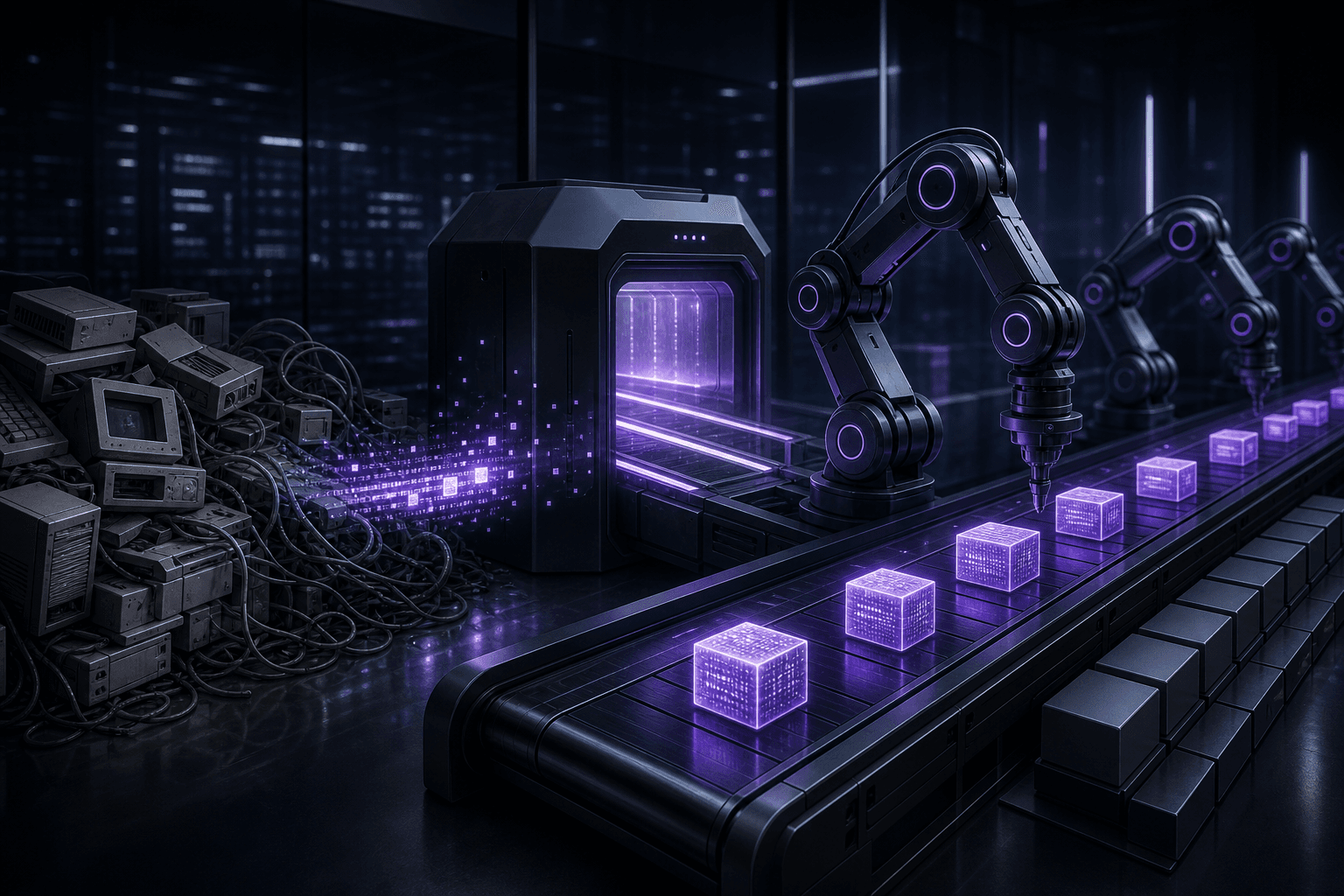
The current generation of AI-native software factories can ingest legacy systems as structured inputs, extract the embedded business logic, and produce production code in a standard, owned tech stack. That capability did not exist at production quality until recently, and it changes the economics of modernization entirely.
The Gap That Most AI Coding Tools Still Miss
It is worth being specific about what distinguishes a governed software factory from the AI coding tools that have become common in enterprise engineering teams.
Tools like GitHub Copilot Enterprise ($39/user/month) are genuinely useful for developer productivity. They accelerate the work that developers are already doing. But they are assistive tools, not governed pipelines. There is no structured workflow from specification to approval gate. There is no audit trail from requirement to commit that satisfies enterprise compliance needs. IP ownership and compliance traceability remain the buyer's problem to solve separately.
Autonomous coding agents like Devin go further - they can plan, write, test, and ship code without constant developer input. But they are still fundamentally developer-productivity tools. They do not ingest legacy systems as structured inputs. They do not provide a traceable control plane. Compliance and IP ownership are not first-class features.
The gap that most AI coding tools miss is governance as architecture. They accelerate the build step. A software factory governs the entire pipeline from business intent to production release, with a single approval gate that puts humans in control of what ships.
This distinction matters most for the buyers who feel it most acutely: CTOs and engineering leaders in regulated industries who cannot afford to ship code without a defensible audit trail, and who need to modernize legacy systems without losing the business logic embedded in them.
What a Working Software Factory Looks Like
A software factory that actually works in 2026 has a few non-negotiable properties.
One traceable control plane. Every stage of the pipeline - specification, work orders, build, verification, approval, feedback - runs through a single connected system. You can trace any release back to the requirement that generated it.
A single governed approval gate. Nothing ships without a human sign-off. This is not a bureaucratic checkpoint; it is the mechanism that keeps the enterprise in control of what the factory produces. The gate is where your team reviews, not rebuilds.
Full IP and code ownership from the first commit. The enterprise owns the code, the IP, and the audit trail. There is no vendor lock-in, no ambiguity about who owns what, and no dependency on a third-party platform to access your own codebase.
Legacy system ingestion as a first-class capability. For the majority of enterprises with modernization mandates, the ability to take undocumented legacy systems as structured inputs is not optional. It is the starting point.
Continuous agentic execution. AI agents execute the build process around the clock. Your team's job is to review and approve, not to build from scratch.
These properties are not aspirational. They describe what a production-ready software factory needs to deliver for enterprise buyers today.
The Operations-Led Model Is New
One of the more significant shifts in 2026 is who drives software delivery. Traditional software development - and most AI coding tools - is developer-led. Engineering teams own the process. Business stakeholders submit requirements and wait.
A governed software factory changes that dynamic. When business intent goes directly into a pipeline that produces production software, operations leaders, compliance officers, and business owners can drive software delivery without waiting for developer capacity to free up. The bottleneck is not the factory floor; it is the approval gate, which is exactly where human judgment belongs.
This is a meaningful organizational shift for enterprises that have struggled to ship internal tools fast enough. The constraint moves from "we don't have enough developers" to "we need to clearly articulate what we want to build" - a much more tractable problem for most organizations.
Why 2026 Is the Inflection Point
The software factory concept has been discussed and attempted for decades. The reason 2026 is different is not hype. It is the convergence of three things that previously did not coexist: agentic execution at production quality, governed pipeline architecture as a first-class design pattern, and legacy system ingestion as a tractable engineering problem.
The enterprises that move early on this model will accumulate advantages that are hard to replicate later: a growing body of owned code, an established governed pipeline, and institutional knowledge about how to translate business intent into production software efficiently.
The enterprises that wait will continue paying the costs of the status quo: developer bottlenecks, stalled modernization projects, and the slow accumulation of technical debt in systems that nobody fully understands anymore.
lumaq is built around exactly this model - a governed AI software factory that takes operational requirements and legacy systems as input and produces production-ready, fully owned software as output. If the architecture described in this article matches the problem your organization is trying to solve, it is worth a closer look at lumaq.ai.
Frequently Asked Questions
What is a software factory?
A software factory is a structured pipeline that converts business requirements into production software through a repeatable, governed process. In its modern form, it combines agentic AI execution with a traceable control plane and a single human-controlled approval gate, so enterprises can produce code at scale without sacrificing compliance or IP ownership.
Why did software factories fail in the past?
Earlier software factory attempts failed for three main reasons: there was no traceable control plane connecting requirements to releases, governance was treated as an afterthought rather than a structural property of the pipeline, and the human bottleneck in the build step was never resolved. AI-native architecture addresses all three.
How is a software factory different from GitHub Copilot or Devin?
AI coding assistants like GitHub Copilot and autonomous agents like Devin accelerate the work that developers do. A governed software factory replaces the entire pipeline from business intent to production release, with a traceable audit trail, a single approval gate, and full IP ownership. Governance is built into the architecture, not managed separately.
What does "governed pipeline" mean in practice?
A governed pipeline connects every stage of software delivery - specification, work orders, build, verification, approval, and feedback - in one traceable system. Every release passes through a single human-controlled checkpoint before shipping. The audit trail exists from the first commit, satisfying enterprise compliance and IP requirements without additional tooling.
Can a software factory handle legacy system modernization?
Yes, and this is one of the most important capabilities for enterprise buyers. A production-ready software factory can ingest undocumented legacy systems as structured inputs, extract the embedded business logic, and produce production code in a standard, owned tech stack. This addresses the comprehension bottleneck that historically made legacy modernization projects slow and expensive.
Who should be driving software factory adoption in an enterprise?
The primary buyers are typically CTOs, VPs of Engineering, and Chief Digital Officers at organizations with active modernization mandates or persistent developer bottlenecks. But a governed software factory also enables operations leaders and compliance officers to drive software delivery directly, without depending on developer capacity.
Is a software factory only relevant for large enterprises?
The model is most compelling for organizations running complex legacy systems or facing significant developer capacity constraints - typically companies with 500 or more employees in regulated industries like financial services, insurance, healthcare, or logistics. Smaller organizations with simpler codebases may find that AI coding assistants are sufficient for their needs.
The software factory model failed for decades because the architecture was not ready. In 2026, it is. The question for enterprise leaders is not whether the model works - it is whether your organization is positioned to use it.