Perspective
AI Software Factory vs. AI Co-Pilot: What Enterprise Engineering Leaders Need to Know Before Choosing
Compare the ai software factory model vs AI co-pilot and get a practical framework to choose the right approach for enterprise engineering teams.
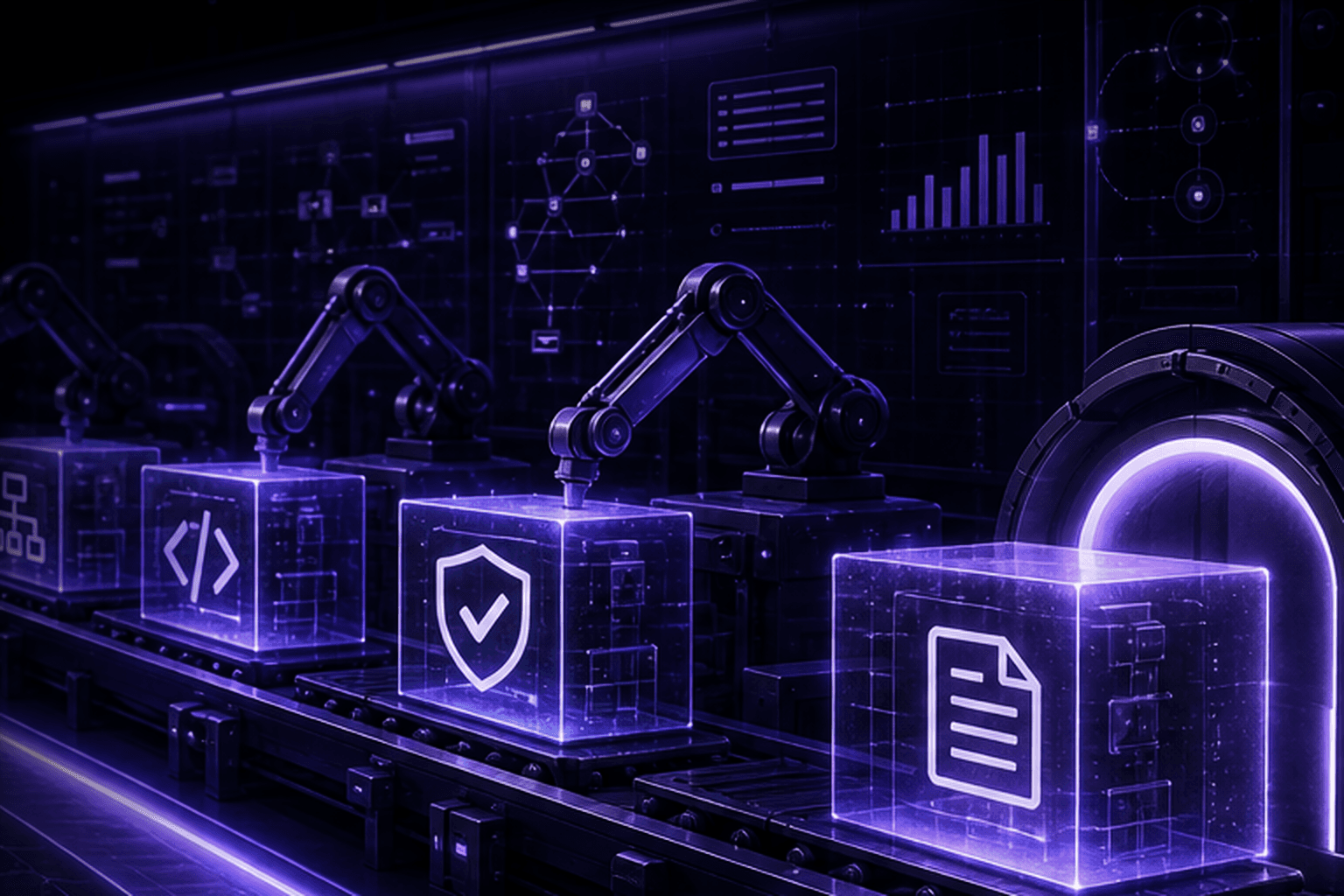
Most enterprise engineering teams have deployed an AI co-pilot. Fewer have asked whether a co-pilot is the right instrument for the problem they actually have. The distinction between an AI software factory and an AI co-pilot is not a matter of scale or budget. It is a matter of scope, governance, and what you are accountable for when something ships.
What follows defines both models precisely, compares them across the dimensions that matter to engineering leaders in regulated environments, and gives you a practical checklist for evaluating any vendor claim.
What Each Model Actually Is
An AI co-pilot - GitHub Copilot, Cursor, and their equivalents - operates at the session level. It assists an individual developer inside an IDE: suggesting completions, generating functions, accelerating the writing of code. The session ends. The developer reviews the output. Whatever happens next - review, testing, approval, deployment - is handled by your existing delivery pipeline, or not handled at all.
An AI software factory is a control plane across the entire software development lifecycle. It takes plain-language intent or a legacy codebase as input and produces requirements, blueprints, work orders, tested code, and an audit trail as output - with a human approval gate before anything reaches production. The scope is not a session. It is the full arc from intent to deployed software.
Both models use AI. The difference is where the AI operates and who is accountable for the output.
The Bottleneck Has Moved
AI has made writing code faster. That is not in dispute. What Bain's 2026 report, "The Missing Architecture for Agentic Software Development," identifies is that speeding up code generation has shifted the bottleneck downstream - to review, governance, and delivery. The constraint is no longer how fast code gets written. It is the gap between "AI wrote it" and "this is safe to ship."
A co-pilot addresses the first half of that sentence. It does not address the second.
Warp's 2026 analysis of software factory platforms makes the structural point clearly: a software factory is a control plane around the SDLC with humans staying in the loop at decision points - approving a spec before code is written, for instance - while coding agents do session-level work inside that loop. The two models are not competitors. One is a component; the other is the architecture that governs it.
The Futurum Group has reported that 94% of surveyed engineering leaders use AI coding tools, and that 55.4% of organizations identify AI agent reliability and hallucination management as their top generative AI challenge. Speed is not the problem. Trust is.
Side-by-Side Comparison
| Dimension | AI Co-Pilot | AI Software Factory |
|---|---|---|
| Scope | Session-level, inside the IDE | Full SDLC: requirements to tested code |
| Governance | Developer-discretionary | Built into the pipeline, not retrofitted |
| Audit trail | None by default | Tamper-evident, end-to-end |
| Approval gate | None - developer merges | Formal human approval before production |
| IP ownership | Depends on vendor terms | Customer owns all code, models, and records |
| Deployment model | Vendor-hosted SaaS | On-prem, private VPC, or air-gapped |
| Regulatory fit | Limited | Designed for regulated environments |
| Agent role | Proposes and writes | Proposes - never merges |
The approval gate row is the one most engineering leaders underweight. In a co-pilot model, the developer decides when to merge. At small scale, that works. At enterprise scale - dozens of agents running in parallel across multiple teams - "the developer decides" is not a governance model. It is an assumption that breaks under audit.
When a Co-Pilot Is Enough
A co-pilot is the right instrument when the problem is developer productivity at the task level. If your team is writing well-scoped features, your review and testing pipeline is solid, your audit requirements are minimal, and you are not operating in a regulated environment with traceability obligations, a co-pilot delivers genuine value. It is fast to deploy, low-friction, and measurably useful for individual contributors.
It is also the right instrument inside a software factory. The two are not mutually exclusive. A governed delivery pipeline can incorporate co-pilot-style agents for code generation while the factory handles requirements, approval, and audit.
When a Co-Pilot Is Not Enough
The co-pilot model breaks down in four specific situations.
You are in a regulated industry. Financial services, aviation, insurance, and telecom all carry traceability obligations that a session-level tool cannot satisfy. When a regulator asks you to demonstrate that a specific piece of code was reviewed, approved, and tested according to a documented process, "the developer used Copilot and merged it" is not an answer.
You are scaling AI agents across teams. One developer using a co-pilot is manageable. Twenty teams running AI-assisted development simultaneously, without a shared control plane, produces inconsistent outputs, undocumented decisions, and no single point of accountability. The governance problem compounds with scale.
You have IP sensitivity. Many co-pilot tools are trained on or send code to vendor infrastructure. If your codebase contains proprietary algorithms, client data, or regulated information, the terms under which that code leaves your environment matter. An AI software factory designed for enterprise use runs on your infrastructure and does not use your code to train its models.
You need an audit trail. Not a log. An audit trail - append-only, tamper-evident, covering the full chain from requirement to deployed artifact. This is a structural requirement for SOX, FedRAMP, and the EU AI Act. A co-pilot does not produce one.
What lumaq Provides as an AI Software Factory
lumaq is a governed AI software delivery platform - a single control plane across the entire SDLC. Feed it plain-language intent or a legacy codebase. It produces requirements, blueprints, work orders, and tested code. Agents propose. A human approves. Nothing merges on an agent's say-so alone.
The output - code, IP, models, and audit records - is fully owned by the customer. lumaq runs on-prem, in a private VPC, or air-gapped, and does not use customer code or data to train its models. The audit trail is tamper-evident and covers every artifact from intent to production.
lumaq is model-agnostic and compatible with existing AI coding agents, including co-pilots. If your teams already use Copilot or Cursor, those tools can operate inside the lumaq pipeline. The factory governs the delivery; the co-pilot assists the build.
For regulated environments where an auditor will eventually ask questions, lumaq holds SOC 2 Type II, ISO 27001, ISO 42001, and GDPR compliance.
What to Ask Any Vendor
Whether you are evaluating lumaq or any other platform that calls itself an AI software factory, these are the questions that separate architecture from marketing.
1. Where does the human approval gate sit? Is it a status flag someone flips, or is it a formal record - append-only, tied to a specific artifact, and auditable? The answer tells you whether governance is built in or bolted on.
2. Who owns the code and the audit trail? Not in principle. In contract. Does the vendor's infrastructure touch your code? Does the vendor's model training use your data? Get this in writing.
3. Can it run on your infrastructure? On-prem, private VPC, and air-gapped are not the same thing. Know which deployment model your compliance obligations require, and confirm the vendor supports it without architectural compromises.
4. What does the audit trail actually contain? A log of events is not an audit trail. An audit trail traces a specific output - a requirement, a blueprint, a commit - back through every decision and approval that produced it. Ask to see a sample.
5. Is the platform model-agnostic? Vendor lock-in at the model layer is a compounding risk. A platform that requires a specific foundation model ties your delivery pipeline to that model's availability, pricing, and policy changes.
6. What happens at the approval gate if the human rejects? This is the test of whether the gate is real. If rejection simply means the agent tries again with no record of the rejection, the gate is cosmetic. If it means a documented finding, a revised artifact, and a new approval cycle, the gate is structural.
FAQs
What is an AI software factory?
An AI software factory is a control plane across the full software development lifecycle. It takes intent or a legacy codebase as input and produces requirements, blueprints, work orders, tested code, and an audit trail as output - with a human approval gate before anything reaches production. It governs the entire delivery pipeline, not just the code-writing step.
Is an AI co-pilot the same as an AI software factory?
No. An AI co-pilot operates at the session level, assisting individual developers inside an IDE. An AI software factory governs the full SDLC, from requirements to deployment. A co-pilot can operate as a component inside a software factory, but it does not replace the factory's governance, approval, and audit functions.
When does an enterprise need an AI software factory rather than a co-pilot?
When the team is operating in a regulated industry, scaling AI agents across multiple teams, handling IP-sensitive code, or facing audit obligations that require a traceable record from requirement to production. A co-pilot is sufficient for individual productivity at the task level. It is not sufficient for enterprise-scale governed delivery.
What certifications should an AI software factory hold?
For regulated industries, the relevant certifications are SOC 2 Type II, ISO 27001, ISO 42001, and GDPR compliance. These are not interchangeable. ISO 42001 is specific to AI management systems and is increasingly relevant under the EU AI Act.
Can an AI software factory work alongside existing AI coding tools?
Yes, if it is model-agnostic and designed for integration. A well-architected software factory governs the delivery pipeline; existing co-pilots and coding agents operate inside that pipeline for the code generation step. The factory does not replace the tools your developers already use - it governs what those tools produce.
The Decision Is Structural, Not Tactical
Choosing between an AI co-pilot and an AI software factory is not a question of how much AI you want. It is a question of where accountability sits in your delivery pipeline. A co-pilot moves accountability to the individual developer. A software factory moves it to the pipeline - with a documented human on the record at the point that matters.
At small scale, individual accountability is manageable. At enterprise scale, in regulated environments, under audit, it is not.
If you are past the pilot stage and trying to scale AI-assisted delivery with governance you can defend, the architecture you need is a control plane - not a session-level assistant.
To discuss what that looks like for your environment, book a scoping call at lumaq.ai.