Delivery
Legacy System Modernization Without a Multi-Year Freeze
Legacy system modernization without a multi-year freeze: learn how to run old and new systems in parallel and prove parity before you cut over.
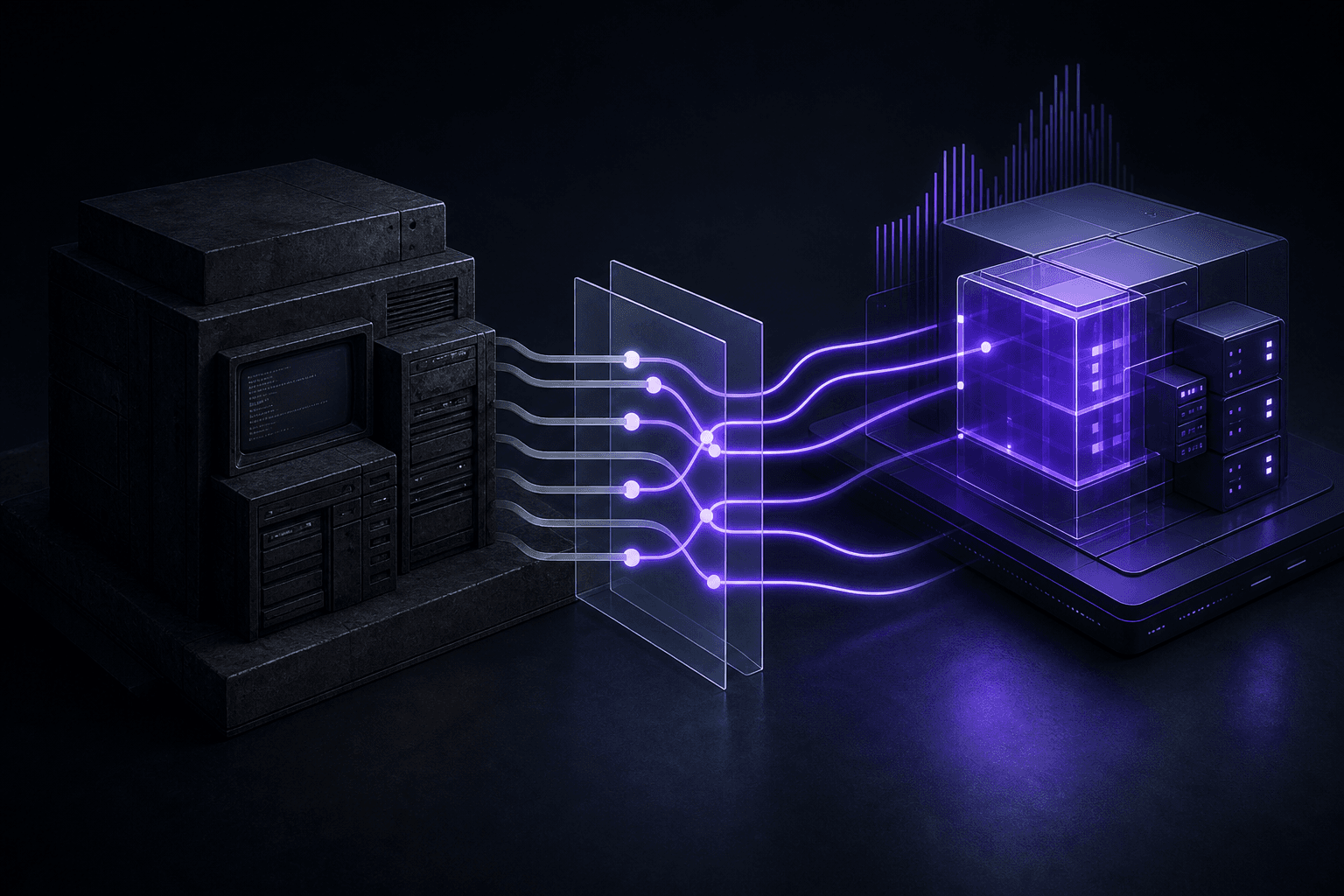
How to run old and new in parallel and prove parity
Legacy system modernization is one of the most consequential decisions an engineering leader makes - and one of the most frequently botched. The conventional instinct is to plan a full replacement, freeze new feature work, and execute a big-bang cutover. That instinct is wrong. The cost of following it is measured in locked-out customers, regulatory findings, and nine-figure write-downs.
The real question is not whether to modernize. It is whether you can do it without stopping the business while you do.
Why the cost of waiting keeps rising
Legacy systems are not just a technical liability. They are a budget trap.
According to the US Government Accountability Office, federal agencies spend roughly 80 percent of their IT budgets operating and maintaining existing systems - leaving almost nothing for new capability. That figure, reported by Abto Software citing GAO data, reflects a pattern that plays out in financial services, aviation, insurance, and telecom just as clearly as it does in government.
Meanwhile, a Stripe developer survey cited by LegacyLeap found that engineers spend 42 percent of their working week on maintenance tasks rather than building new features. That is nearly half your most expensive resource doing work that produces no competitive advantage.
The longer you wait, the more the system calcifies. Documentation disappears. The engineers who understood it retire. Integrations multiply. Every year you delay, the eventual modernization becomes more complex and more expensive.
Five approaches to legacy system modernization
Not every modernization is the same. The right approach depends on the system's criticality, the quality of existing code, the regulatory environment, and how much business disruption you can absorb.
| Approach | What it means | Best for | Risk |
|---|---|---|---|
| Lift-and-shift | Move to new infrastructure, no code changes | Fast cloud migration, short-term cost relief | Defers the real problem |
| Refactor | Restructure code without changing behavior | Maintainability improvements, tech debt reduction | Scope creep, regression risk |
| Re-architect | Redesign system structure (e.g., monolith to microservices) | Scalability, team autonomy | High complexity, long timelines |
| Rewrite | Build from scratch in a modern stack | When legacy is beyond salvage | Big-bang risk if done wrong |
| Replace | Adopt a commercial or SaaS product | Commodity functions, low differentiation | Vendor dependency, data migration |
Most enterprises end up combining approaches - refactoring some components, re-architecting others, replacing commodity functions outright. The mistake is treating any of these as a single, synchronous project.
Why big-bang cutovers fail
The appeal of a big-bang rewrite is clarity. One cutover date. One system in production. No parallel running costs. It feels decisive.
It is also how modernization projects fail.
NRI Digital Consulting puts the failure or significant underperformance rate of modernization projects at 68 to 79 percent. The structural reason is not poor planning or weak engineering. It is that you cannot fully specify a system's behavior until you have run the new version against real production load - and by then, a big-bang cutover has already burned the bridge back.
TSB's 2018 migration of 5.2 million customer accounts is the canonical example. The cutover locked out 1.9 million customers and produced a loss of £330 million. The root cause was not a single technical failure. It was the architecture of the migration itself: everything moved at once, with no fallback path. Both figures are cited in a 2026 Security Boulevard analysis of the strangler-fig pattern.
The lesson is not that rewrites are impossible. It is that synchronous, all-at-once cutovers remove your ability to recover when something goes wrong - and something always goes wrong.
How to run old and new in parallel
The strangler-fig pattern is the structural answer to big-bang risk. The name comes from the strangler fig tree, which grows around an existing tree and gradually replaces it while the host continues to stand.
In software terms: you route specific capabilities or traffic slices to the new system while the legacy system continues to handle everything else. The new system grows. The legacy system shrinks. At no point is the business frozen.
A few things have to be in place for this to work.
Traffic routing and feature flags. You need a proxy or gateway layer that can direct requests to either system based on configurable rules. Not complicated - but it must be deliberate from day one.
Shared data or synchronized state. Both systems must agree on the state of the world. Dual-write patterns, event sourcing, or a canonical data layer can handle this depending on the architecture. Neither system can become the sole source of truth until the cutover is complete.
Incremental scope. Modernize one bounded context at a time - a payment processing module, a customer identity service, a pricing engine. Each is a contained migration with a defined rollback path.
Clear exit criteria. A legacy component does not get retired until its replacement has run in production, under real load, for a defined period - and passed parity validation.
Parity validation: making the legacy system the oracle
Parity testing is the discipline that makes parallel running trustworthy. The definition is precise: for any given input, the new system must produce the same output and the same state changes as the legacy system. When documentation is missing or incomplete - which is almost always - the legacy system's actual behavior becomes the oracle.
This matters more than most teams appreciate. Legacy systems accumulate undocumented behavior over decades. Edge cases handled by a COBOL subroutine written in 1994. Rounding logic that was never in a spec. Tax calculations patched after a regulatory change and never documented. The new system must replicate all of it - not just the behavior described in whatever documentation survives.
Parity testing works by running both systems against the same inputs: production traffic replays, synthetic test suites, and adversarial edge cases. Discrepancies are findings, not failures. Each one is investigated - is the legacy behavior correct and must be preserved, or is it a bug the new system should not replicate?
Done manually, this process is slow. Automated, it is tractable. It is also the only honest way to declare that the new system is ready to take over.
Where AI helps - and what governance it needs
AI-assisted legacy modernization changes the economics of the reading and rebuilding work. Agents can ingest a legacy codebase, map its dependencies, generate requirements from observed behavior, and produce modern-stack equivalents at a pace no human team can match.
But "AI wrote it" is not the same as "this is safe to ship." That gap is where modernization projects using ungoverned AI tooling accumulate new risk even as they retire old code.
The governance requirements are specific.
Agents must propose. They must not merge. Every artifact - requirement, blueprint, generated module - needs a human approval gate before it enters the delivery pipeline. One approval, on the record, with a tamper-evident audit trail that shows what was proposed, who approved it, and when.
The audit trail matters especially in regulated environments. Financial services firms under SOX, aviation systems under DO-178C, and insurers operating under Solvency II cannot simply assert that a modernized system behaves correctly. They need to prove it, with records that survive an audit. An append-only audit trail capturing every agent action and every human decision is not optional in those environments. It is the difference between a modernization that can be defended and one that cannot.
The legacy codebase itself is intellectual property. The new system, any models trained on it, and the generated code all need to be owned by the enterprise - not retained by a vendor, not used to train shared models, not locked into a proprietary stack.
What to look for in a modernization approach
Before committing to an approach or a delivery partner, these questions are worth asking directly.
- Does the approach allow the legacy system to keep running in production throughout the migration, or does it require a freeze?
- Is there a defined parity validation process, and does it use the legacy system as the behavioral oracle?
- Do AI agents propose changes, or do they merge them autonomously?
- Is there a human approval gate before any generated code reaches production, and is that approval recorded in an immutable audit trail?
- Who owns the generated code, the IP, and the audit records at the end of the engagement?
- Can the new system run on-premises, in a private cloud, or air-gapped - or does it require a vendor-managed environment?
- What happens to the legacy codebase data after the engagement ends? Is it used to train shared models?
These are not procurement formalities. They are the questions that determine whether a modernization can be defended to a board, a regulator, or a customer who was locked out during a failed cutover.
How lumaq approaches this problem
lumaq is built for exactly this constraint. Feed it a legacy codebase and it produces requirements, blueprints, work orders, and tested code - with agents proposing at every stage and a human approval gate before anything reaches production. The output is fully owned by the customer. Code, IP, models, and the complete audit trail belong to the enterprise, not to lumaq.
The platform runs on-premises, in a private VPC, or air-gapped. Nothing from your codebase is used to train shared models. The audit trail is append-only and tamper-evident - every agent action and every human decision is on the record.
For legacy modernization specifically, lumaq supports parallel running: the legacy system stays in production while the new system is built, validated against it, and incrementally cut over. Parity validation uses the legacy system's behavior as the oracle. The cutover happens in slices, not in a single synchronous event.
Learn more at lumaq.ai.
FAQs
What is legacy system modernization?
Legacy system modernization is the process of replacing, refactoring, re-architecting, or rebuilding aging software systems to reduce technical debt, improve maintainability, and enable new capabilities - while keeping the business operational throughout.
What is the strangler-fig pattern and why does it matter?
The strangler-fig pattern is an incremental modernization approach where new components are built alongside the legacy system and gradually take over its functions. It avoids big-bang cutover risk by keeping the legacy system in production as a fallback until each new component has been validated.
What is parity testing in legacy modernization?
Parity testing verifies that the new system produces identical outputs and state changes to the legacy system for any given input. When documentation is incomplete, the legacy system's actual behavior serves as the oracle - the authoritative definition of correct behavior.
Why do most modernization projects fail or underperform?
NRI Digital Consulting estimates that 68 to 79 percent of modernization projects fail or significantly underperform. The most common structural cause is a synchronous, all-at-once cutover that removes the ability to recover when unexpected behavior surfaces in production.
What governance does AI-assisted modernization require?
AI agents should propose changes, not merge them autonomously. Every generated artifact needs a human approval gate before it enters the delivery pipeline, and that approval must be recorded in a tamper-evident audit trail. In regulated industries - financial services, aviation, insurance - this is not optional. It is what makes the modernization auditable.
Who should own the code and IP produced during a modernization?
The enterprise should own everything: the generated code, any models trained on the legacy codebase, and the complete audit trail. Vendor retention of codebase data or generated IP creates both commercial and regulatory risk - particularly in sectors where data sovereignty and IP ownership are subject to regulatory scrutiny.
The choice is not between modernizing and not modernizing. The cost of the legacy system is already compounding. The real choice is between a freeze-and-replace approach that concentrates all the risk in a single cutover event, and an incremental approach that keeps the business running, proves equivalence at each step, and preserves a path back if something goes wrong. One of those approaches carries a 68-to-79-percent failure rate. The other does not require you to bet the business to find out.